
TAKING THE HELM
The Use of AI in the Boardroom
an ongoing series with Professor Mervyn King

Professor Mervyn E. King
Renowned authority on corporate governance, ethics, and sustainability, and chair of the Taking the Helm webinar series.
Part of the Taking the Helm series with Professor Mervyn King, this webinar explores the growing use of AI in the boardroom and its implications for governance, oversight, and decision-making.
Key questions answered
The role of a director is best understood through the metaphor of the “Guardian.” Historically, a guardian is appointed to protect a “ward”—an incapacitated person. A company is a legal persona that, while powerful, has no heart, mind, or conscience of its own; it is effectively incapacitated. The director is the human element that provides that heart, mind, and conscience.
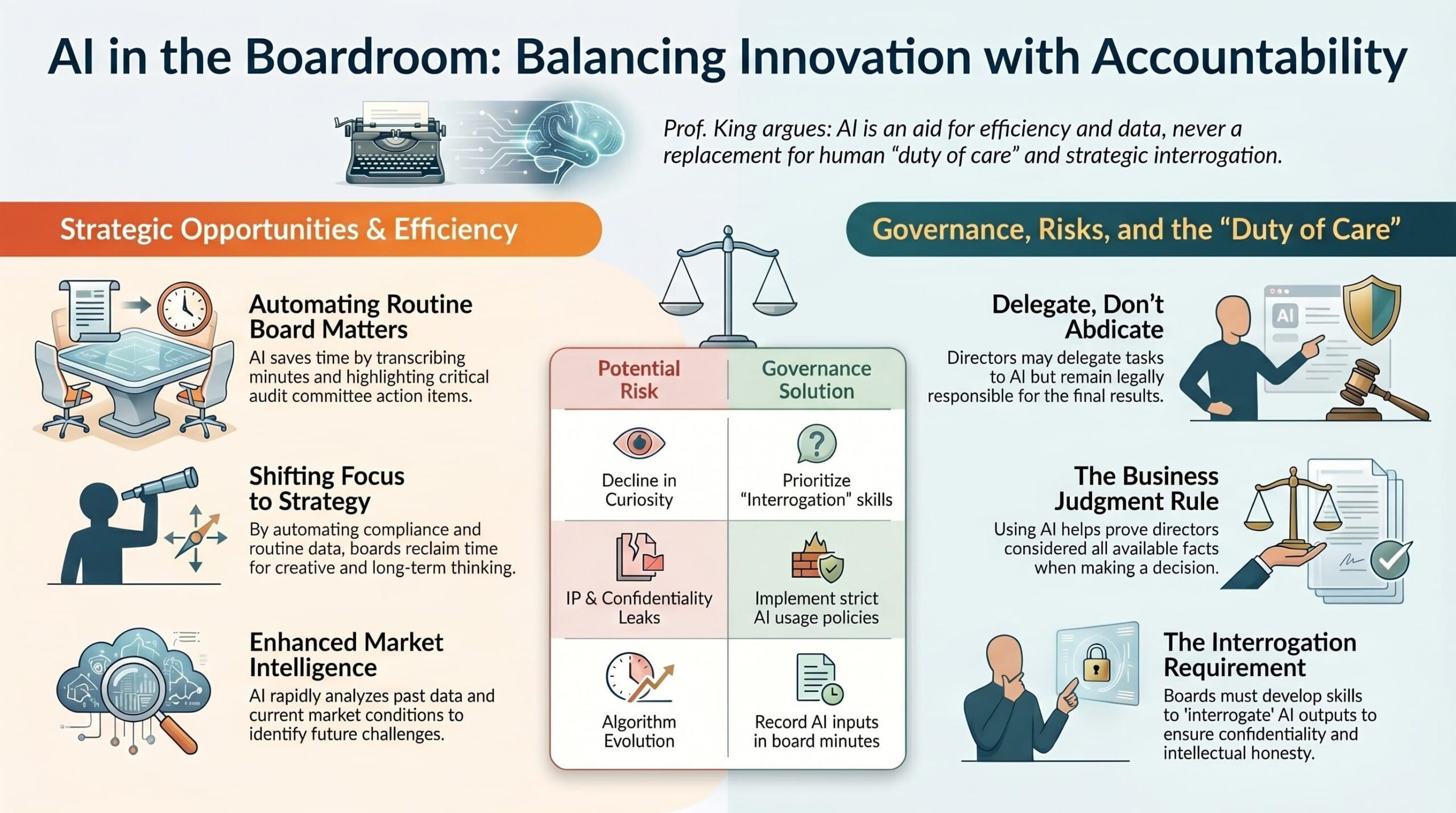
In this new industrial revolution, AI must be viewed as an “aide,” not the “outcome.” While AI can provide the facts and analyze the trends with unprecedented speed, the final business judgment must remain a product of the collective human mind, fueled by intellectual honesty and an inquiring spirit. Directors must place the “ward’s” interests above their own, using AI to clear the path of routine matters so they may focus on the true essence of governance: the long-term health and sustainability of the company.
The trajectory of corporate reporting has undergone a radical transformation, moving from the mechanical to the cognitive. For modern directors, maintaining a perspective on this shift is a strategic necessity. We have moved from an era of physical correction to one of automated synthesis. Understanding this evolution allows leaders to recognize that while the tools have changed, the fundamental requirement for informed oversight remains constant, even as the risk of technological complacency grows.
In the early iterations of the King Reports, the production of governance documentation was a grueling physical process. Prof. Mervyn King recalls the era of typewriters equipped with “steel arms” and carbon ribbons, where typing too quickly resulted in tangled machinery. The “miracle” of that age was Tip-X—a literal paint used to cover errors. Today, that has been replaced by the “miracle” of the backspace key and generative AI summaries. We have transitioned from computers that occupied half a building to astronauts carrying iPhones around the moon. This shift from “physical correction” to “automated synthesis” represents a profound change in the board’s capacity to process knowledge, moving the strategic impact of technology from the periphery to the very heart of boardroom decision-making.
Integrating AI into the boardroom is not about replacing human judgment but enhancing it. AI serves as a powerful aide that sharpens the board’s collective mind, allowing directors to reclaim “thinking time” by automating data-heavy routine tasks. When leveraged correctly, it allows a board to move beyond mere compliance and into deep, proactive strategic inquiry.
AI provides several key functional differentiators that empower modern directors:
- Financial Position and Audit Oversight: AI can instantly generate and analyze balance sheets and profit and loss statements, providing the Audit Committee with immediate clarity on the company’s financial health.
- Peer Remuneration Benchmarking: The Remuneration Committee can use AI to compare executive pay structures across listed companies with near-instantaneous precision, ensuring competitive and justifiable compensation strategies.
- Market Condition Monitoring: AI identifies immediate competitive challenges and global shifts, enabling the board to refine strategies to meet these specific hurdles in real time.
- Strategy Stress-Testing: Directors can utilize AI to critique proposed corporate strategies, asking the tool to provide an opposing view or identify weaknesses in the board’s assumptions.
- Routine Automation: By summarizing previous minutes and highlighting critical action items from committee reports, AI eliminates administrative bottlenecks, freeing the board to focus on long-term value creation.
This shift fundamentally alters the legal landscape, as the availability of these tools redefines what constitutes a director’s “Duty of Care.”
The Business Judgment Rule (BJR) is the primary safeguard for directors, protecting those who make honest, informed calls in a volatile environment without the benefit of a crystal ball. However, the emergence of AI significantly raises the bar for what is considered an “informed” decision.
Under the Companies Act, directors are protected from liability if they meet three criteria:
- They have no personal financial interest in the matter.
- Objectively speaking, they had all the facts reasonably available to them.
- The decision was “reasonable” under the circumstances.
A critical litigation risk—often called “The Susan Question”—arises from the four-year litigation horizon. If a board decision is challenged four years from now, the courts and plaintiffs will not be evaluating the decision with today’s tools; they will be testing it with the AI tools of the future. To meet this future evidentiary standard, directors must use AI today to ensure they have accessed all “objectively available” facts.
Directive for Boards: To protect against the evolution of algorithms, board minutes must move beyond recording resolutions. They must proactively record the specific AI generative tools used and the specific outputs provided at the time of the decision. This “freezes” the facts in time, proving that the director acted reasonably based on the information available at that specific moment, rather than being judged by a more advanced algorithm years later.
The fundamental principle of governance remains: directors may delegate tasks to technology, but they can never abdicate their statutory responsibilities. Intellectual honesty requires that the “heart and mind” of the company remain human.
The Risk of “Layering” and Intellectual Property
Boards must be vigilant regarding “Layering.” This occurs when middle management uses AI to write reports, which are then fed into the board’s own AI tools for summarization. This compounding of machine-generated content from the bottom up risks degrading the quality of original thinking and obscuring critical nuances. Furthermore, using public AI tools for board packs risks “leaking” confidential intellectual property and strategic secrets onto the public internet, where they may be consumed by competitors.
The Decline of the “Curious Mind”
Expertise requires an inquiring mind, yet research in the UK has identified a concerning trend. After five years of online teaching and heavy reliance on voicemail transcriptions for assignments, there was a measurable decline among students in creative thinking, problem-solving, and curiosity. For a director, curiosity is a core attribute. Without it, the board risks “rubber-stamping” AI-generated reports without the necessary interrogation.
Strategic Recommendations:
- Develop the “Art of Interrogation”: Boards must move beyond accepting reports. Like a pension fund trustee interrogating an asset manager on sustainability pillars (economy, society, and environment), directors must test the “why” behind AI and management findings.
- Establish an “AI Generative Tool Committee”: Boards should consider a dedicated committee to set policies and controls. This body would dictate how far management can go in using AI and ensure full disclosure of which tools were used in preparing board packs.
- Test Individual Diligence: The Chair should call on individual directors to explain the rationale behind their vote in detail, ensuring they have actually understood the synthesized reports rather than simply relying on an AI summary.
Governance Inquiry | Expert Response & Strategic Rationale |
|---|---|
Can a director delegate decision-making to AI? | No. You can delegate the data gathering, but you can never abdicate the responsibility or the duty of care. |
How does AI impact the Business Judgment Rule? | It helps satisfy the requirement that, objectively speaking, you accessed all facts reasonably available at the time. |
Should AI use be recorded in board minutes? | Yes. Record the specific tool and output to protect against future litigation where algorithms will have evolved. |
What are the risks of public AI tools? | Massive risk of leaking confidential IP and strategy to the public internet and competitors. |
How does the Chair ensure director diligence? | By “picking” on directors to explain their vote, testing if they actually understood the report or just the AI summary. |
What is the “Layering” risk? | The compounding of AI-generated content from middle management up to the board, which may obscure original human thought. |
Is a new board structure required? | Yes. An “AI Generative Tool Committee” should be formed to set rules, policies, and disclosure requirements for AI use. |
Glossary of Key Terms
Term | Definition |
|---|---|
Abdication | The improper act of a director surrendering their legal responsibility or accountability to another party or technology. |
Business Judgment Rule | A legal principle providing that directors escape liability for harmful decisions if they had no financial interest, acted on all available facts, and made a decision that was reasonable under the circumstances. |
Carbon Ribbon | A historical typewriter component used to create an ink imprint on paper, mentioned as part of the technology used for the first King Report. |
Duty of Care | A statutory requirement for directors to act with a specific level of prudence, skill, and diligence in their service to the company. |
Golf Ball Typewriter | A technological innovation in typing where a spherical element rotated to strike characters, replacing individual steel arms. |
Incapacitated Person | In a legal context, a persona (like a company) that has no heart, mind, or conscience of its own and requires directors to act as its guardians. |
Intellectual Honesty | The requirement for directors to truly understand the matters they vote on and to admit when they do not understand a report or data point. |
Interrogation | The active process of questioning and testing the information provided by management or AI to ensure its validity and relevance. |
Layering | The process of adding multiple levels of AI analysis to a single data set as it moves from management to the board. |
Legal Persona | The statutory status of a company as a “person” with limited liability, existing separately from its directors or owners. |
Peer Remuneration | The process of comparing salary and benefit levels with other listed companies, a task that can be simplified using AI tools. |
Tip-X | A white correction fluid used historically to paint over typing errors so they could be retyped once dry. |