
Academic publishing is changing rapidly. Researchers, editors, reviewers, journals, and academic institutions are facing increasing expectations around research quality, ethical integrity, international visibility, indexing, citation impact, responsible use of artificial intelligence, and the long-term sustainability of scholarly communication.
This Journal Webinar will explore how today’s publishing challenges can become opportunities to strengthen research quality, build trust, increase global recognition, and support more impactful academic communities.
About this webinar
In an increasingly competitive scholarly environment, academic publishing is no longer simply about producing papers. It is about creating trustworthy knowledge, strengthening research credibility, and contributing meaningfully to society.
Hosted as part of the Good Governance Talks – Journal Webinar Series, this session provides a strategic perspective on the changing dynamics of scholarly communication. The discussion considers the challenges and opportunities shaping academic publishing today, including publication ethics, reviewer engagement, responsible use of AI, journal visibility, international indexing, citation impact, and the growing importance of interdisciplinary and socially relevant research.
The webinar also explores practical approaches for improving publication success, enhancing journal quality, building international research networks, and supporting the long-term reputation and sustainability of academic journals and scholarly initiatives.
Explainer video
Podcast-style
Key questions answered
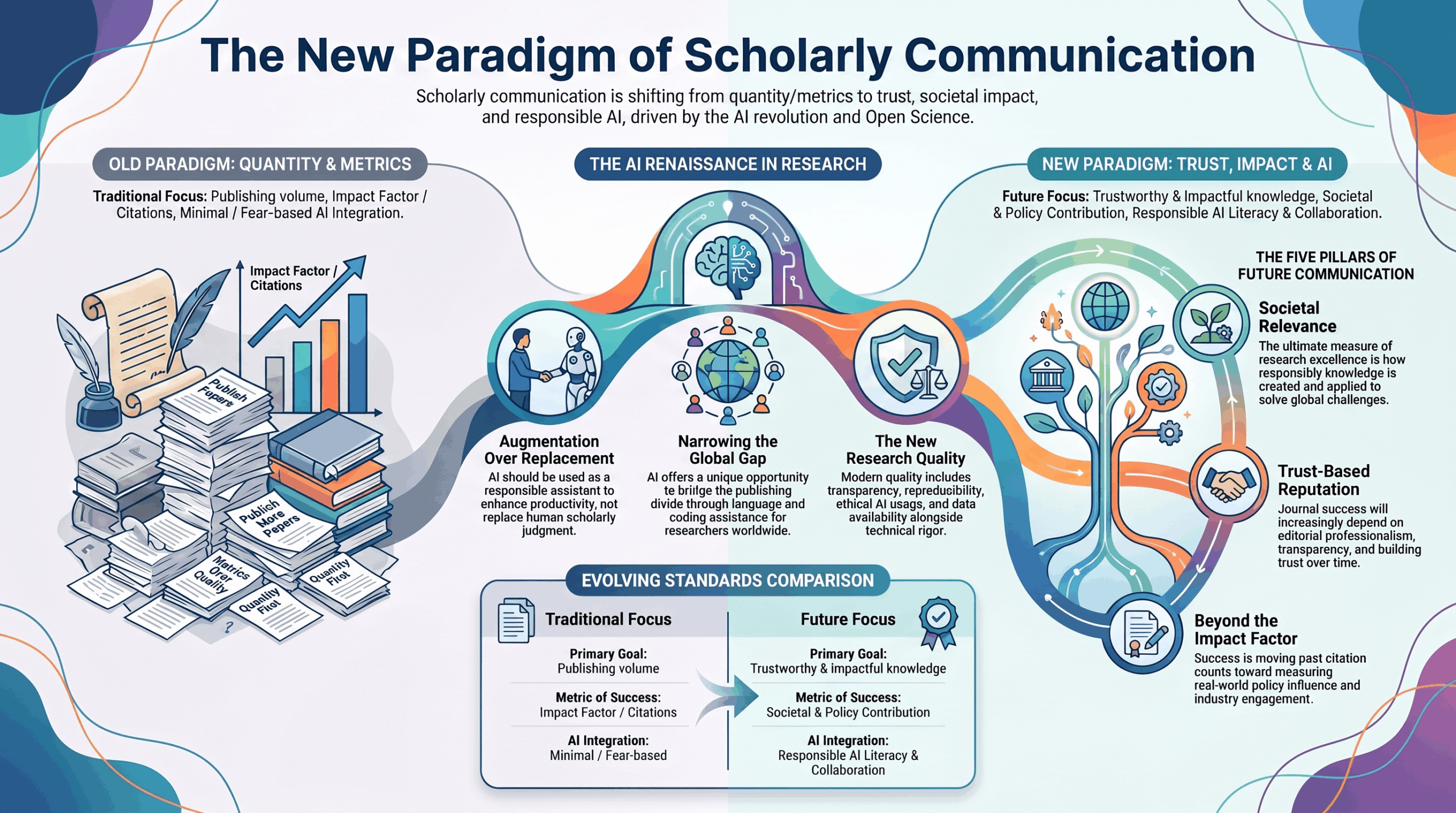
Scholarly communication is currently navigating a fundamental paradigm shift.
The academic world is moving away from a volume-based “publish or perish” model, which has long incentivized quantity over substance, toward a value-based framework centered on trust, global visibility, and demonstrable societal impact. As we transition from traditional print and digital journals to integrated, AI-assisted knowledge ecosystems, we must address the critical operational questions regarding the human-machine interface in the editorial process.
The Five Pillars of Future Scholarly Communication
The future of academic publishing is anchored by five strategic pillars:
- Quality: A transition from technical content to a focus on transparency and reproducibility.
- Integrity: The mandate for ethics and responsible AI usage in every step of the research lifecycle.
- Visibility: Utilizing international indexing and AI-driven discoverability to reach a global audience.
- Impact: Prioritizing societal, policy, and industry contributions over raw citation counts.
- Sustainability: Developing resilient journals and collaborative networks that can withstand the increasing volume of global publications.
The future belongs not to those who publish the most, but to those whose work is the most trusted, discoverable, and socially beneficial. We must remember that knowledge grows when it is shared, and impact grows when we collaborate. It is the responsibility of every researcher to ensure that their work is not merely a line on a CV, but a genuine contribution to the improvement of global society.
There is a profound strategic anxiety regarding the automation of scholarly workflows. History reminds us that every technological leap—from the introduction of writing itself, which Socrates feared would weaken human memory, to 20th-century protests by educators against the use of calculators—has been met with the fear that machines would stop humans from thinking. In the current era, defining the boundary between machine efficiency and human accountability is critical for maintaining institutional integrity.
AI should be viewed as a tool for the democratization of opportunity, not the removal of human intellect.
Strategically, we must distinguish between different editorial functions. AI is already proving capable of replacing the technical tasks of language editors—correcting prose, refining syntax, and assisting non-English speaking researchers to compete on a global stage. However, AI cannot replace the “Scholarly Judgment” of a Chief Editor. Accountability, the perception of justice in the peer-review process, and the ability to explain a decision rationally rather than through mere statistical relationships are human requirements.
The strategic goal is to utilize AI to reduce administrative costs and increase transaction speeds while ensuring that human editors remain the ultimate arbiters of scientific truth.
Institutional standards must pivot to acknowledge that rigor, the very foundation of scientific credibility, is being redefined. In an environment where AI tools are ubiquitous, a paper’s quality is no longer solely a matter of methodology; it is a matter of transparency and digital reproducibility.
Modern Era Qualities
Rigor in the post-AI landscape must be redefined to mandate the following:
- Ethical use of AI: Researchers must provide explicit transparency regarding the extent of AI involvement in data analysis and drafting.
- Data Availability and Openness: True rigor now requires that data, code, and research protocols are shared to allow for external verification.
- Verifiability Beyond Correlation: Rigor includes the researcher’s ability to interpret results and verify that they are not the product of AI-generated hallucinations or fabricated references.
This internal rigorous standard serves as the prerequisite for a paper’s ultimate success: its impact on the world.
We are seeing a necessary strategic shift away from the “Impact Factor” as the sole measure of academic success. While citations in prestigious journals provide academic prestige, they often fail to capture whether a piece of research has actually solved a global challenge. To remain relevant to stakeholders and funders, research must justify its existence through its contribution to society and policy.
Current measurement systems are too narrow.
We must pivot toward identifying “Real-world changes” that can be traced directly back to scholarly work.
“Research excellence will be measured not only by what we publish, but by how responsibly we are creating, communicating, and applying the knowledge… to genuinely improve society.“
Key Societal Impact Indicators include:
- Policy Influence: Citations within government documents, legislative frameworks, and the working papers of policy institutions like central banks.
- Industry and Business Cooperation: The direct implementation of theoretical findings or simulation results into commercial applications.
- Social and Environmental Outcomes: Demonstrable improvements in fairness or environmental protection, such as the application of complex carbon tax calculations to national climate strategies.
AI literacy is no longer an optional elective; it is a strategic necessity for the survival of higher education. The risk to graduate programs is not the existence of LLMs, but a “Divide of Capabilities” where degrees may be granted for machine outputs rather than intellectual development.
Academic advisors must mandate a clear distinction between “Positive Usage” and “Unethical Usage” at the very beginning of the thesis process.
- Positive Usage: Utilizing AI for coding assistance, clarifying complex concepts, or improving the clarity of one’s own arguments.
- Unethical Usage: Allowing AI to generate the paper’s core arguments or original voice.
Advisors must warn candidates early that if AI replaces the researcher’s voice, the intellectual value of the degree is nullified. We must produce researchers who can leverage AI to process vast amounts of data in real-time, but who retain the critical analytical skills to manage risks and optimize operations independently of the machine.
Historically, the global scholarly ecosystem has been hindered by geography and language, leading to massive inefficiencies and research duplication. Knowledge was often siloed behind linguistic barriers that human effort alone could not bridge.
AI is the “Renaissance tool” that is finally resolving the language barrier.
Through Large Language Models (LLMs) and advanced discovery platforms, researchers can now identify similar work across different languages and universities globally. Furthermore, specific regional infrastructures (e.g. the TÜBİTAK/DergiPark system in Turkey) are providing digital trails for publications that enhance traceability even before formal indexing. This technology is turning a historical “Divide of Knowledge” into a “Global Digital Collaboration,” allowing for multidisciplinary research that transcends borders.
Assoc. Prof. Sezer Bozkus Kahyaoglu
Professor Kahyaoglu is an Associate Professor of Finance at the Accounting and Finance Department of Izmir Bakircay University as well as the Edior and Chief of the ACG Journal. Her professional and academic interests include financial markets and instruments, applied econometrics, energy markets, corporate governance, risk management, fraud accounting, sustainable finance, ethics, and auditing.


Prof. Bilal Bağış
Prof. Bilal Bağış will bring academic experience and insight to a timely discussion on the evolving landscape of scholarly communication, with a focus on research quality, publication success, journal visibility, and the future of academic publishing.
Glossary of terms
Term | Definition |
|---|---|
AI Literacy | The set of skills and knowledge required for researchers to integrate artificial intelligence into their workflows responsibly and effectively. |
CPD Requirements | Continuing Professional Development; requirements for participants to prove engagement in an event to receive certification for their organizations. |
Divide of Capabilities | An emerging inequality in academia based on access to AI tools, computational resources, and digital research infrastructure. |
Impact Factor | A traditional metric used to measure the importance of a journal based on citations; however, it is increasingly viewed as an insufficient sole measure of success. |
Least Publishable Unit | A practice in which researchers break down a single study into the smallest possible parts to increase publication counts; discouraged in favor of holistic, high-quality contributions. |
Living Articles | A future publishing trend where research papers are dynamic and continuously updated rather than static print documents. |
Open Science | A movement focused on redefining research accessibility, emphasizing reproducibility, data sharing, and transparent protocols. |
Peer Review Manipulation | The unethical use of AI or other means to circumvent the standard review process, potentially compromising the credibility of published science. |
Reproducibility | The ability of other researchers to achieve the same results using a study’s data and methodology; a core component of modern research quality. |
Scholarly Communication | The system through which research and other scholarly writings are created, evaluated for quality, disseminated to the scholarly community, and preserved. |
Societal Impact | The real-world effect of research on the community, environment, or economy, such as informing policy changes or solving industry problems. |
Sustainability (Research) | The resilience of journals and collaborative networks and their ability to evolve alongside changing technology and evaluation systems. |