
Hidden Costs - Visible Data
Measuring Corruption at the Public–Private Interface in the Digital Era
Corruption at the interface between business and the public sector distorts competition, raises costs, and undermines inclusive growth
As public services become more digital, corruption risks are not disappearing, they are evolving. This webinar explores how corruption can be measured more effectively, and why better data is essential for stronger, more targeted integrity reforms.
Join this webinar for an inside view of how UNDP measures corruption at the global level: the methodologies used, how the data is produced, and where its limits lie. More than a presentation, this session opens space for critical discussion on how corruption is currently understood, what existing data misses, and how more actionable evidence can support better governance and policy design.
What You’ll Learn:
- How corruption is measured at the global level
- The strengths and limitations of existing corruption data
- Why more granular evidence matters for policy and reform
- How improved measurement can support more targeted integrity interventions
explainer video
Podcast-style summary
Key Inquiries and Insights
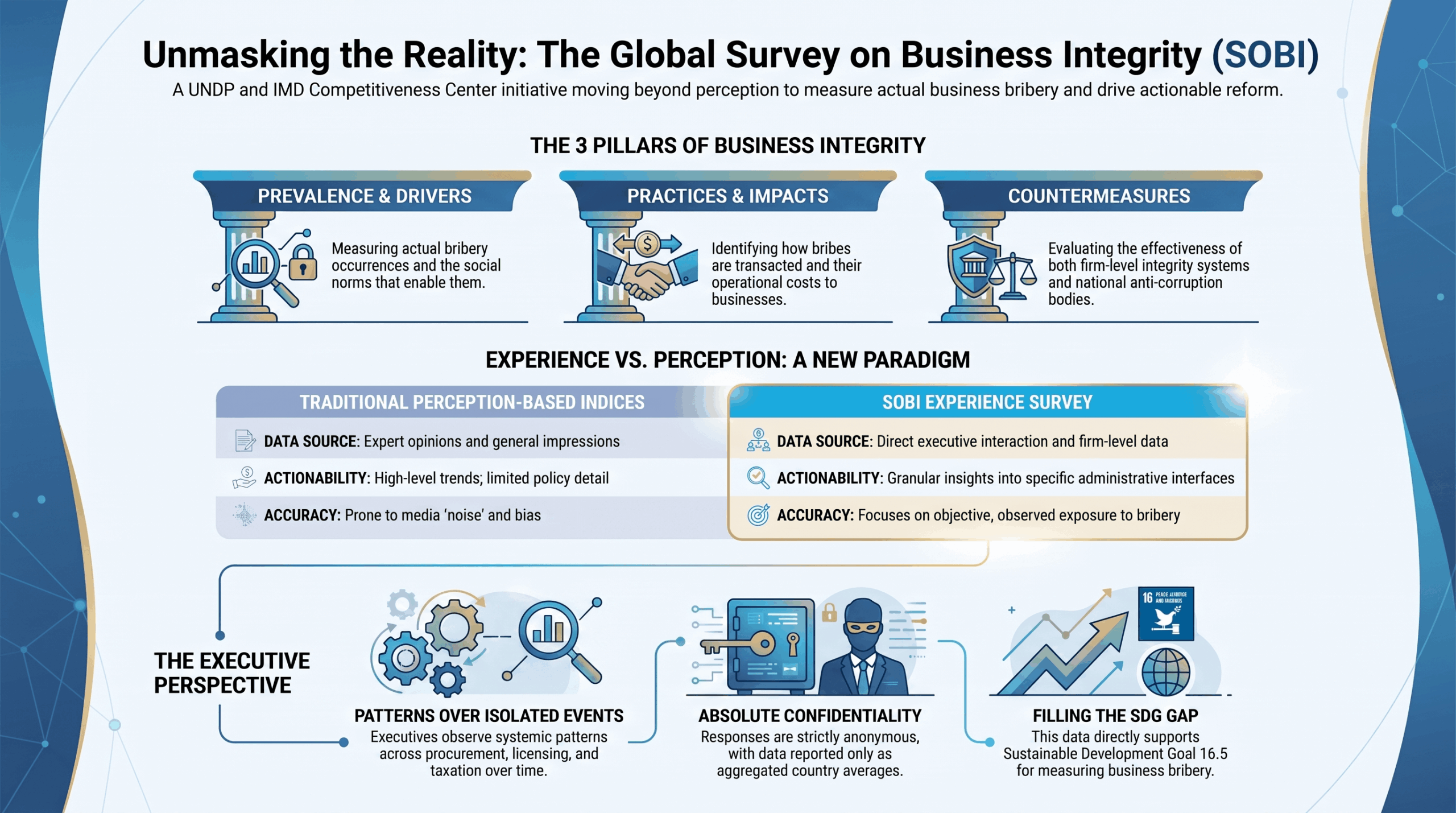
Effective anti-corruption policy requires a fundamental strategic shift from measuring how corruption is perceived to measuring how it is actually experienced. For decades, international benchmarks relied heavily on perception-based indices, which provided a general sense of a country’s reputation but offered little in the way of granular, evidence-based data required for reform. Fatma Usheva’s “iceberg” framework necessitates a move toward experience-based data; what is reported to authorities or detected by agencies represents only the visible tip of a much larger, submerged volume of illicit activity.
By contrasting indirect methods—such as expert assessments and composite indices like the Corruption Perception Index (CPI)—with direct surveys and administrative data, researchers can bypass the subjective “noise” that often detaches perception from the actual frequency of bribery. The primary limitation of relying on expert opinion is the inherent lack of actionable findings. While a low ranking signals a problem, it fails to identify specific administrative interfaces or the mechanics of the exchange. Without data that pinpoints where and how corruption occurs, real-world reform remains stalled, lacking the roadmap necessary to address systemic vulnerabilities. This demand for precision leads directly to the methodological innovations found in the Survey on Business Integrity (SOBI).
The Survey on Business Integrity (SOBI) is engineered to fill the technical data voids left by broader global indicators. While the World Bank Enterprise Survey (WBES) tracks approximately 160 economies, its methodology focuses heavily on small and medium-sized enterprises (SMEs) and often utilizes only a narrow, integrated module for corruption. In contrast, SOBI—coordinated through the IMD World Competitiveness Center’s network of local WCC Partner Institutes across 60 countries—is a dedicated instrument designed to explore the systemic “mechanics of the game.”
The technical distinctions between SOBI and traditional surveys are critical for data-driven governance:
- Target Demographic: SOBI specifically targets large enterprises and top-to-middle-level executives, moving away from the SME-heavy samples of the WBES.
- Depth of Inquiry: Rather than simple prevalence counts, SOBI investigates the institutional conditions and social norms that drive illicit behavior.
- Methodological Innovation: To mitigate “self-incrimination bias,” SOBI employs “informed indirect experience,” asking executives about the behaviors of their direct competitors.
- SDG Alignment: SOBI serves as a direct technical complement to Sustainable Development Goal (SDG) 16.5.2, providing the depth required to fulfill international mandates for comparable data.
Focusing on executive perspectives provides a more accurate reflection of a country’s business sector because these individuals interact with high-risk administrative interfaces, such as large-scale procurement and international taxation. Their strategic vantage point allows them to observe persistent patterns across transactions over time, distinguishing systemic corruption from isolated “petty” incidents. This clarity is essential for understanding why businesses participate in corrupt systems in the first place.
For a policymaker, quantifying the number of bribes paid is less valuable than diagnosing the “pull” and “push” factors of the environment.
Gergely Hideg’s SOBI framework distills these factors into five dimensions:
- Prevalence: Measuring actual exposure within a standardized 12-month period.
- Drivers: Identifying institutional conditions like “regulatory opacity,” where unclear rules force firms to pay for clarity, and social norms—the corrosive belief that “everyone is doing it.”
- Practices: Distinguishing between direct cash bribery and “relational exchanges” or “insider exchanges,” such as cronyism.
- Impact: Quantifying the operational toll on the firm.
- Countermeasures: Evaluating the effectiveness of internal firm-level integrity systems and external national anti-corruption bodies.
This framework reveals that grand corruption is system-agnostic; even highly-regarded democracies are not immune. For instance, despite the perceived strength of the “Norwegian-Scandinavian model,” the discovery of high-level elites on “Epstein Island” illustrates that social norms and power-driven corruption can bypass the strongest rule-of-law institutions. Furthermore, “unpredictable enforcement” creates a new level of corruption where laws are weaponized against specific competitors. In these environments, justice institutions themselves become tools for extortion, creating a tangible economic drain that stifles market competitiveness.
The discourse on corruption must shift from moralistic judgment to an analysis of economic “disadvantages.” Measuring the tangible impact of corruption is essential for establishing integrity as a core component of a competitive operating environment. When corruption dictates market winners, the quality of a firm’s innovation becomes secondary to its political connections.
Panelists have identified specific “impact points” that halt capital flow:
- Investment Delays: Uncertainty causes firms to pause infrastructure projects or capital allocation.
- Market Entry Barriers: Corrupt gatekeepers frequently exclude foreign or non-aligned firms from “protected” sectors.
- Procurement Opportunity Loss: For large enterprises, exclusion from “preferred circles” in government contracting represents a massive revenue drain.
Jose Caballero emphasizes that these impacts transform integrity from an abstract concept into a business necessity. When the state-business interface is compromised, the resulting “data noise” obscures true market value and deters long-term investment. Navigating these risks requires businesses to operate within a complex “gray zone” where legal engagement and criminal bribery often overlap.
Defining the boundaries of corruption is complicated by overlapping cultural norms and legal frameworks. The UN Convention Against Corruption (UNCAC) remains the “guiding star” for legality, yet the application of these standards requires nuanced interpretation of “undue advantage.”
The Rolex vs. Chocolate Analogy
Context is paramount in defining a bribe. Within the framework of the 2015 South Korean graft law, clear boundaries were established to distinguish between cultural gestures and illicit influence. While a box of chocolates may be a harmless exchange, a luxury item like a Rolex creates an undue obligation, signaling systemic corruption.
Political Campaign Contributions
The rise of “diffuse” financing—such as social media-led campaigns and contributions from non-natural persons (corporations)—creates significant risks. These methods often circumvent traditional caps on political giving, blurring the lines between legitimate support and influence-peddling.
The Wage Paradox and Case Studies
Strategic analysis of the Hong Kong case study reveals a significant paradox: increasing civil service pay can effectively reduce “petty corruption” driven by survivability, but it leaves “grand corruption” untouched.
High-level corruption is driven by power and systemic influence rather than salary deficiencies. This distinction underscores the need for SOBI’s anonymous, executive-level data. By utilizing Qualtrics-based consistency checks and 12-month residency requirements for respondents, SOBI provides the rigorous, validated evidence needed to illuminate these hidden patterns and drive substantive governance reform.
MEET THE SPEAKERS


Fatma Usheva
Fatma Usheva is a Governance Data Specialist at the UNDP Global Policy Centre for Governance. Her work focuses on advancing governance statistics to better inform policy and institutional reform, particularly in the areas of representation, access to justice, and corruption under SDG 16. She has supported the development of international statistical frameworks and has led governance and crime survey implementation across multiple countries.
Anga Timilsina
Anga Raj Timilsina is UNDP’s Global Advisor on Governance and Anti-Corruption at the UNDP Oslo Governance Centre. He coordinates policy and programme support for anti-corruption reforms across more than 60 countries, including work to strengthen integrity in public institutions, business, and civil society. He is also leading UNDP’s global initiative on measuring corruption, including integrity in public procurement and business experiences with bribery.
Gergely Hideg
Gergely Hideg is a senior survey statistician and governance expert serving as Lead Expert for the drafting of the Global Report on Business Experiences with Bribery and Its Drivers under UNDP’s Global Programme on Governance for People and Planet. His work focuses on policy-relevant data and measurement in governance, corruption, and public integrity, with extensive experience supporting internationally comparable data and SDG 16-aligned measurement frameworks.
Glossary of key terms
Term | Definition |
|---|---|
ACRC | The Anti-Corruption and Civil Rights Commission (specifically mentioned in the context of South Korea’s integrity index). |
CPD / CPE | Continuing Professional Development / Continuing Professional Education; requirements for professionals to engage with the webinar for certification. |
Direct Bribery | A transaction where a payment, gift, or favor is given in exchange for an undue advantage or service. |
Discretion | The power of officials to make decisions; when used without predictable enforcement, it becomes a driver for corruption. |
Grand Corruption | High-level corruption involving political elites and large-scale state resources, often occurring even in well-established democracies. |
Kickback | A percentage of a contract or payment (e.g., 20%) returned to an official in exchange for a procurement advantage. |
Petty Corruption | Every-day corruption involving lower-level officials, such as bribing a police officer to avoid a speeding ticket. |
Regulatory Opacity | A lack of clarity in rules and regulations that makes it difficult for businesses to know how laws are enforced. |
Relational Influence | Gaining advantages through social networks, cronyism, or “insider exchange” rather than through direct monetary bribes. |
SOBI | Survey on Business Integrity; the primary tool developed by UNDP and IMD to measure corporate-level experiences with corruption. |
UNCAC | United Nations Convention Against Corruption; the “guiding star” and international treaty ratified by over 190 states to combat corruption. |
Undue Advantage | A benefit or service that a person or business is not legally entitled to, obtained through corrupt means. |