
About This Event
Corporate governance has become a lived discipline, tested daily in boardrooms, shareholder meetings, state-owned entities, digital transformation projects and moments of organisational crisis.
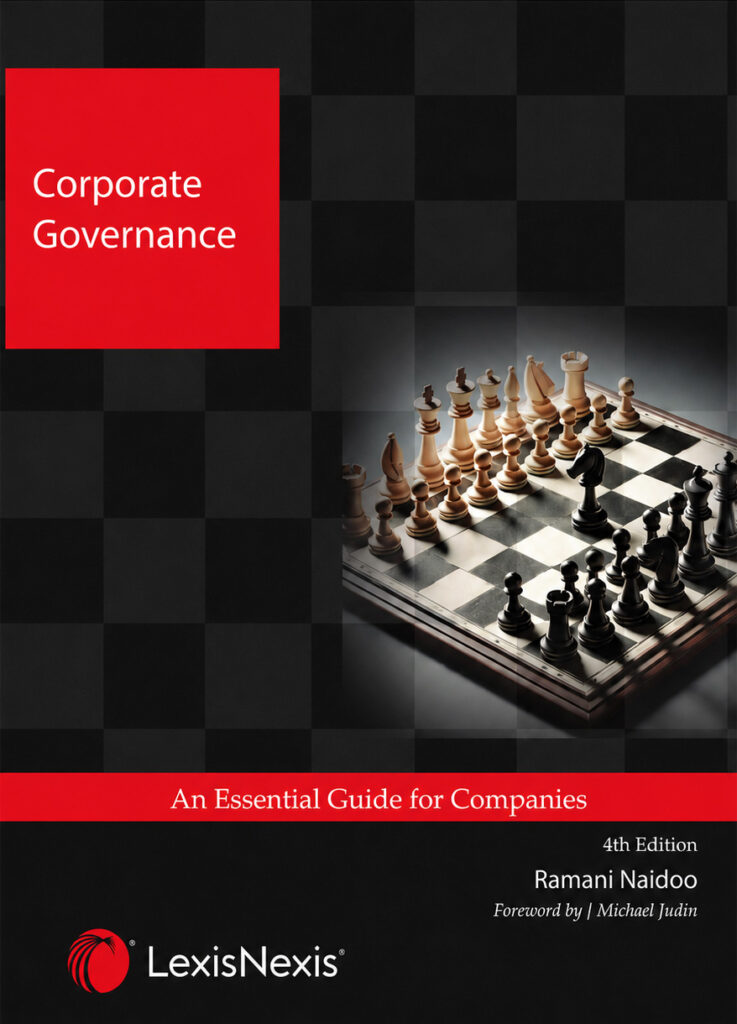
Join the Good Governance Academy for a timely conversation with Ramani Naidoo, author of the newly released 4th edition of Corporate Governance – An Essential Guide for Companies. This session will explore how governance practice is evolving in South Africa and globally, and why directors, executives, company secretaries and governance professionals need practical clarity in an increasingly complex environment.
The discussion will also feature Lionel Moyal, contributor to the book’s chapters on technology and AI governance, who will bring a focused perspective on responsible digital transformation, artificial intelligence and the governance questions boards must now confront.
Why this Matters
Boards and leadership teams are facing a governance environment shaped by legal reform, stakeholder expectations, digital disruption, ESG demands, cybersecurity risk, artificial intelligence and the continued lessons of corporate failure.
This webinar will unpack how modern governance can move beyond box-ticking and become a practical tool for judgement, accountability and ethical leadership.
Key Discussion Areas
- What has changed in the 4th edition of Corporate Governance – An Essential Guide for Companies
- How South African governance practice fits within a wider global context
- The role of boards in navigating complexity, reform and organisational accountability
Key Questions Answered
Institutional stability rests upon a delicate strategic tension: the formal architecture of structural compliance versus the underlying reality of behavioral integrity. While frameworks, charters, and codes of conduct provide the necessary scaffolding, they are insufficient for long-term survival if they lack the substance of active oversight. True governance is not a static state of “having complied” but a dynamic practice of exercising judgment and maintaining the courage to interrogate information when the provided answers do not suffice.
Why do governance scandals continue to occur despite decades of increased regulation and established codes?
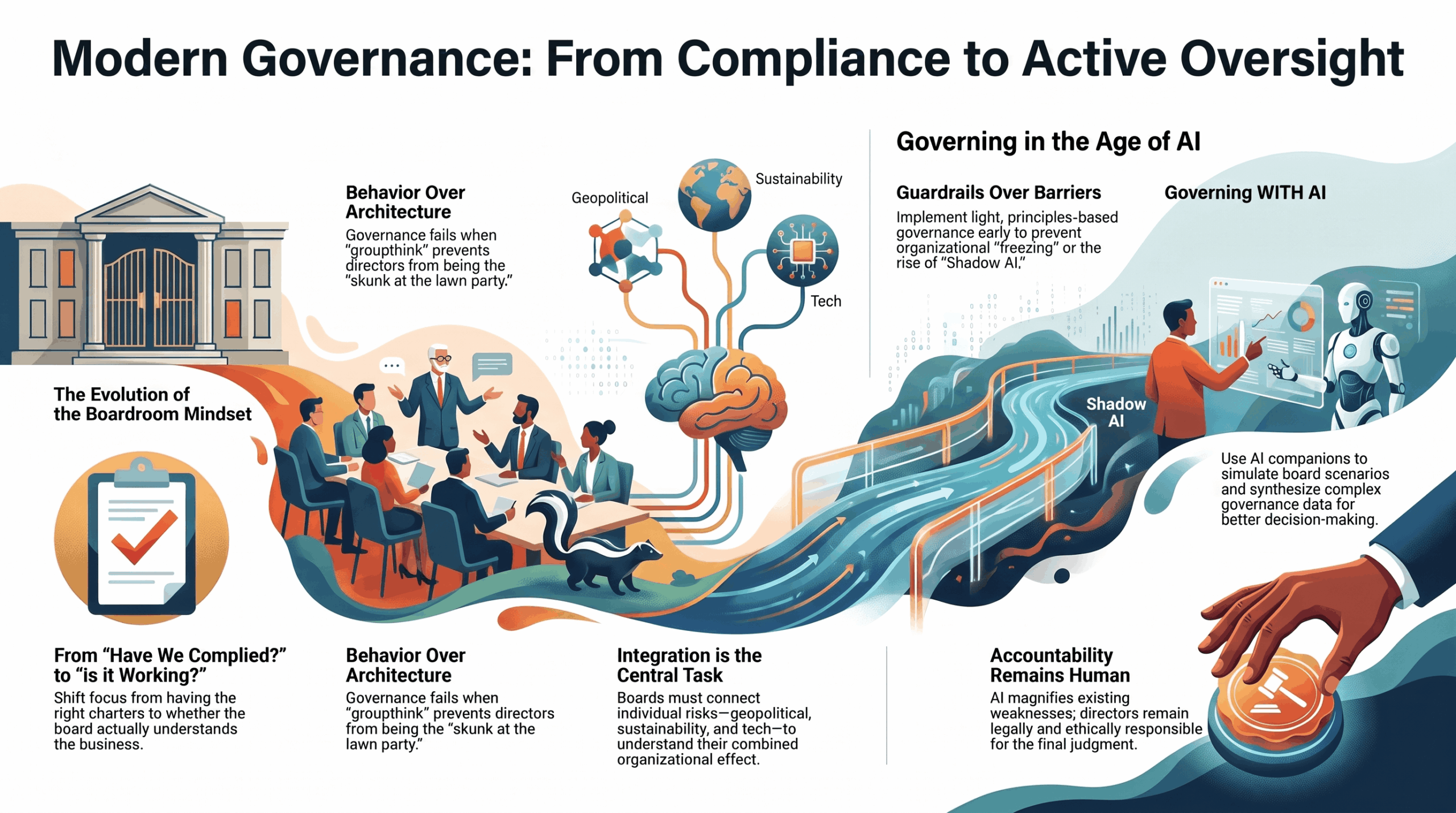
The persistence of corporate scandals highlights a critical distinction between governance architecture and governance behavior.
Boards rarely fail because the language of governance is absent; they fail because the behaviors that give those structures meaning, such as critical inquiry and the testing of evidence, are lacking. Often, a confident assurance from management is treated as though it were objective evidence, even when the underlying logic is flawed.
To counter the slip from collegiality into groupthink, a board requires a “skunk at the lawn party”, a director prepared to disturb the comfort of the room and interrogate inconsistencies that others might prefer to ignore. Without this willingness to be the “difficult person,” boards remain blind to emerging crises.
Recent history provides definitive illustrations of these failures:
- Steinhoff: The board and stakeholders accepted the premise that the company could continue making highly profitable acquisitions year after year, even as the global financial crisis devastated the rest of the world. The behavior of skepticism was missing, and management’s “assurance” was accepted at face value.
- Tongat Hulett: This case demonstrates how blurred accountability and conflicts of interest destabilize institutions. During its business rescue, the Vision Consortium acted as both the proposed purchaser and the lead secured creditor—two potentially conflicting commercial roles that eventually led to a collapse of the sale.
- PIC/Lanceria Airport: This unfolding saga involving the Public Investment Corporation (PIC) illustrates how quickly governance can erode. What began as a question about financing an airport investment escalated into whistleblower allegations, suspensions, and board resignations, proving that even with trillions in assets under management, behavior remains the primary point of failure.
If behavior is the core of effective governance, it must now be applied to an increasingly volatile global landscape where traditional risk silos are no longer viable.
Modern boards must move away from siloed risk management toward a model of integrated oversight. In a volatile geopolitical environment, risks can no longer be neatly categorized into “IT,” “Finance,” or “Legal.” A shock in one area invariably triggers a cascade across the entire organization, necessitating a board-level view that synthesizes these disparate signals into a coherent strategy for preparedness and resilience.
How should boards adapt their oversight to manage risks that do not fit into single categories?
Integration has become the central task of the modern board. Directors must look beyond individual committee reports to understand the “combined effect” of global events. For example, a conflict in the Middle East is not merely a geopolitical headline; every attack on ships in the Strait of Hormuz sends oil prices higher, increasing freight costs and insurance premiums while disrupting supply chains. Similarly, sudden policy shifts, such as a 50% tariff imposed on Canadian exports, can instantly threaten margins and business continuity.
To move from mere prediction to active preparedness, boards must ask five specific Resilience Questions:
- Concentration: Where are our critical suppliers, our critical markets, and inputs concentrated?
- Disruption: What could disrupt any of those nodes?
- Alternatives: Do we have credible alternatives in place?
- Absorption: Can our liquidity and margins absorb the disruption?
- Transparency: At what point should stakeholders be told?
This shift from general global complexity leads directly into the specific technological disruptions currently reshaping the boardroom, most notably the rise of artificial intelligence.
Boards must maintain a dual focus regarding artificial intelligence: they must mitigate the systemic risks AI introduces while capturing the competitive advantages of utilizing AI within board processes. Distinguishing between the “governance of AI” and “governing with AI” is essential for maintaining a modern fiduciary stance.
What is the fundamental difference between the “governance of AI” and “governing with AI”?
The distinction lies between establishing “guardrails” and “reimagining possibilities.”
- Governance of AI: This is a risk and compliance function. It involves setting principles for fairness, privacy, transparency, and safety. Boards must ensure a registry of AI use cases exists to prevent “shadow” deployments and ensure risk-based compliance as seen in the EU AI Act.
- Governing with AI: This is about strategic augmentation. It involves using AI to tackle larger problems, process complex data sets, and provide objective viewpoints.
The future of board dynamics is shaped by Agentic AI: models that do not just provide text but are authorized to take action, such as talking to other systems, sending emails, or approving claims based on reasoned plans.
This shift requires specialized Interactive Governance Resources: Virtual Board Members like Gaius (General Governance), Lex (Legal), and Aria (Technology). These are not generic chatbots; they are digital personas trained on vast bodies of specialized governance knowledge. They can participate in meetings, provide real-time risk summaries, and suggest conditions for transactions, acting as tireless, objective consultants to the human directors.
While AI can significantly augment board capabilities, its integration raises critical questions about the final location of responsibility.
In an era of automated decision-making and agentic systems, fiduciary duty remains non-negotiable and strictly human. While technology can process information at a scale impossible for humans, it cannot hold the moral or legal weight of accountability. The ultimate responsibility for the organization’s actions cannot be outsourced to a model or a vendor.
Who is ultimately responsible when an AI system produces a flawed output or a wrong decision?
Accountability remains human. Expert consensus dictates that while AI can advise, human judgment is the final test of governance.
- A board cannot defend a flawed decision by claiming they were “assured by the AI” or that the system was a “black box.” Directors are answerable for the final outcome, including the duty to ensure human-in-the-loop controls are active for all agentic systems.
- If the board fails to understand the underlying logic of an AI’s recommendation, they have effectively vacated their fiduciary office.
The use of AI magnifies existing board weaknesses, particularly through Information Asymmetry.
This occurs when the board becomes overly dependent on management or third-party vendors for technical explanations they cannot verify. If a board lacks the literacy to challenge an AI-driven output, they risk falling into the same trap as past governance failures: treating a polished digital presentation as evidence rather than a claim to be tested.
Meeting this accountability mandate requires a foundational shift in technical competency among all directors.
Technological literacy has shifted from a specialized skill to a foundational requirement for all directors. As AI becomes embedded in supply chains, HR, and financial reporting, a director who lacks AI literacy is as hindered as one who cannot read a balance sheet.
How much technical expertise do directors actually need to oversee AI and emerging technologies?
Directors do not need to build neural networks, but they must possess a “Mental Model” of AI’s functional mechanics.
This model includes understanding:
- Neural Networks and Tokenization: AI doesn’t “read” words; it transforms language into numbers (tokens) to identify mathematical patterns.
- Pre-training vs. Post-training: Pre-training allows the model to detect patterns from vast data (the entire internet), while post-training teaches it the nuances of human dialogue and conversation.
- Tools and Reasoning: Modern AI uses “tools” (like browsers or code-interpreters) and “reasoning” to build step-by-step plans to solve complex problems.
A critical aspect of literacy is distinguishing between unauthorized “Shadow AI” and the organization’s official strategy.
Feature | Shadow AI (The Risk) | Official AI Strategy (The Goal) |
|---|---|---|
Visibility | Unmanaged; used by employees in secret. | Documented in a formal Use-Case Registry. |
Data Safety | Personal accounts; potential IP leaks. | Enterprise-grade security and data privacy. |
Governance | No oversight; no human-in-the-loop. | Built on principles (Fairness, Accountability). |
IP Value | Benefits individuals only. | Captured in a Corporate “Skills Registry.” |
To bridge the knowledge gap, boards should adopt:
- Reverse Mentoring: Connecting veteran directors with younger technologists to learn how AI tools are used in practice.
- Skills Registries: Formally tracking the AI “recipes” (the specific prompts and instructions) that constitute the company’s new intellectual property.
The ultimate goal is to move from the appearance of governance to the practice of governance.
By combining a robust mental model of technology with the traditional courage to ask difficult questions, boards can lead their organizations through the complexities of the digital age.
About the Book
Corporate Governance – An Essential Guide for Companies is a widely used governance text for directors, executives, company secretaries, governance professionals and students seeking practical guidance in a complex field.
Now in its 4th edition, the book expands its focus to include global governance developments, disruptive governance, AI, cybersecurity, ESG, ethical leadership and the practical realities of boardroom decision-making.
Explainer Video
Podcast-style Summary

Author | Corporate Governance Specialist | Business Leader
Ramani Naidoo is a South African governance specialist, lawyer, author and business leader with extensive experience across law, corporate governance, boardroom practice and ethical leadership. She has served as a director of listed and unlisted companies, as well as a company secretary, bringing together practical executive and boardroom experience with deep governance expertise.
AI & Technology Governance Contributor | Technology Leader
Lionel Moyal is a technology leader and advocate for responsible digital transformation, innovation and AI governance. His experience spans startup founding, technology leadership, strategic growth, finance, operations and executive leadership. As a contributor to the 4th edition, he brings a practical perspective on technology in the digital age and the governance of artificial intelligence.
Glossary of Key Terms
Term | Definition |
Agentic AI | AI systems that go beyond reasoning to take autonomous action, such as sending emails or approving expense claims, based on authorized decisions. |
AI Companion | A digital interactive resource containing virtual board members (e.g., Lex, Aria, Remi) trained on governance texts to provide real-time consulting and summaries. |
Collegiality | A sense of team unity in the boardroom; however, the text warns it can slip into “groupthink” if directors are too polite to disagree. |
Information Asymmetry | A governance weakness magnified by AI, where there is a gap in knowledge between the board and the experts/management regarding technical details or data quality. |
Integration | The central governance task of bringing together disparate risks (geopolitical, tech, ESG) to understand their combined effect on the organization. |
King V | The latest iteration of the South African governance code, which provides guidance on AI use cases and board accountability. |
Materiality | In sustainability governance, the determination of which specific risks (e.g., water quality, carbon emissions) actually affect a company’s specific business model. |
Neural Networks | Mathematical models (vector databases) that transform language into numbers (tokens) to identify patterns in data at scale. |
Post-training | The process of feeding AI models additional patterns of human dialogue to enable them to converse in a natural, engagement-focused way. |
Reasoning Models | Advanced AI models taught to think step-by-step and build a logical plan to solve complex problems rather than just predicting the next word. |
Shadow AI | The unmanaged use of AI tools within a company (often via personal accounts) that happens outside the awareness or control of the board. |
Tokenization | The process of assigning a number to every word in a dictionary so that computers (specifically GPUs) can find patterns in language. |