
Board Capabilities That Matter.
A follow-up conversation on the capabilities boards need to govern effectively in a changing environment.
about this topic…
Effective governance depends not only on board structures and processes, but on the capabilities that boards bring to their role. As organisations face increasing complexity, uncertainty, and stakeholder expectations, boards are being asked to demonstrate stronger judgement, oversight, adaptability, and collective effectiveness.
This event explored the idea of board capabilities and why they matter in practice. It considers how boards can better understand the capabilities needed for effective governance, where capability gaps may emerge, and how these can be strengthened over time to support better decision-making and long-term organisational value.
Hosted by Colette Chriton, Head of Governance Solutions at the Good Governance Academy, this session continues the conversation on what meaningful board effectiveness looks like in practice.
short explainer
podcast-style summary
key questions answered…
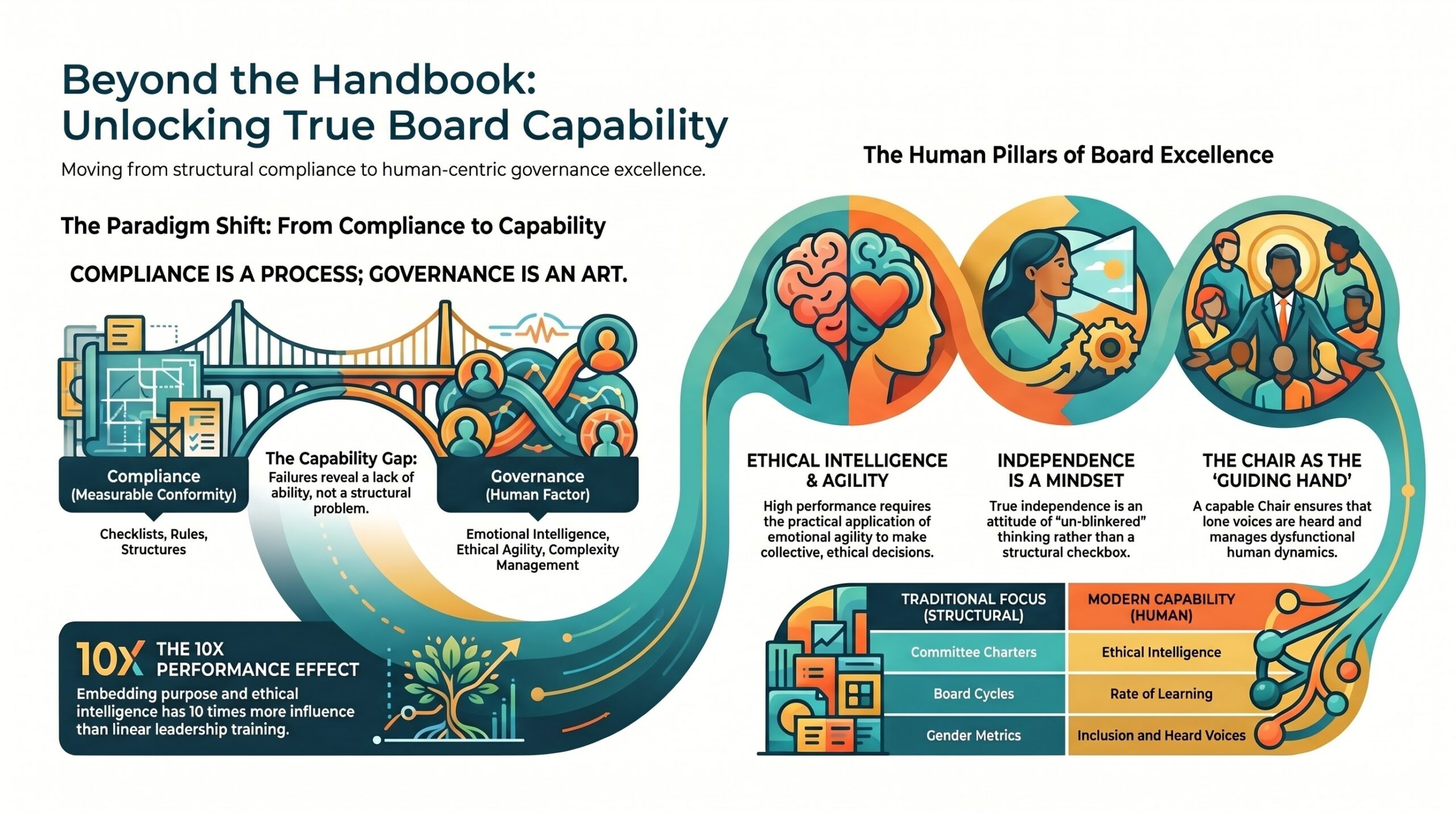
In many boardrooms, “compliance” and “governance” are erroneously used as synonyms, creating a strategic blind spot that invites ruin. Compliance is a measurable, non-negotiable process anchored in the present; it ensures conformity to laws, codes, and practices. Governance, conversely, is a “human factor” art focused on the future and the prudent management of risk. As Patrice Lasserre emphasizes, we must adopt Bob Garratt’s definition: governance is “the art of moving the organization forward while keeping it under prudent control.” It is a function of judgment and behavior rather than mere documentation.
The following table contrasts these two distinct domains:
Compliance (The Process) | Governance (The Art) |
|---|---|
Measurable: Directly tracked against external codes and legal statutes. | Behavioral: Rooted in attitude, culture, and ethical intelligence. |
Non-negotiable: Conformity is a mandatory legal or regulatory baseline. | Judgment-based: Centered on the nuance of human decision-making. |
Present-focused: Concerned with current status, adherence, and box-ticking. | Future-focused: Focused on steering the entity through risk and volatility. |
Structural: Validated through frameworks, charters, and formal records. | Functional: Validated by how the board performs as a unified collective. |
Treating governance as a mere extension of process leads boards to miss “warning signals sitting in plain sight.” When a board prioritizes compliance metrics over the art of governing, it loses the functional capability to handle uncomfortable information or engage in the robust debate necessary to spot risks before they materialize. Effectiveness is not found in the handbook, but in the collective ability to use structural tools to exert meaningful oversight.
Mapping the topography of where these capabilities actually reside is the non-negotiable prerequisite for board optimization.
Identifying the “location” of capability is vital for board development because it dictates how an organization is “steered.” If capability is misidentified, development efforts remain superficial. Drawing from Perrin Carey’s sporting team analogy, a board can assemble the most brilliant individual players, but if they lack the “rules of the game” or a “referee,” they are simply a group of people doing something without purpose.
True capability is a symbiotic manifestation across three layers:
- Individual Capability
- Knowledge and Experience: The baseline technical skills and professional history.
- The Willingness to Learn: A critical trait in a landscape where the rate of director learning must outpace the rate of external change.
- Collective Capability
- Collaborative Nature: The ability to function as a cohesive unit with shared values.
- Robust Debate: The capacity to host disagreement and ensure a “lone voice” is genuinely considered.
- Structural Capability
- The Rules of the Game: The systems, board charters, and frameworks that define the boundaries of play.
- The “Referee” Function: The structural mechanisms that ensure the board is actually performing against its intended purpose rather than just following a process.
The “secret sauce” of high performance is cohesiveness, yet individual brilliance is often the enemy of collective capability. Boards comprised of high-performing individuals frequently fail because strong egos prevent the formation of a unified steering body. Without the synergy of these three layers, a board remains a collection of disparate experts rather than a high-functioning governing entity capable of managing complex systems.
Locating where capability resides is only the first step; the board must then apply that collective power to the volatile technical frontiers of the modern era.
The boardroom is currently haunted by “FUD” (Fear, Uncertainty, and Doubt) surrounding emerging technologies. It is strategically unrealistic to expect every director to become a subject matter expert in AI or climate science, particularly when the technical landscape shifts from one social media post to the next. Such expectations do not just fail; they set the board up for operational overreach.
As Carolyn Chalmers suggests, boards should utilize “independent committee members” or “expert advisors” to bridge these gaps. These specialists serve a specific function:
- Expert Integration: They bring the technical depth to understand management’s “minutiae” while operating with a board-level mindset focused on long-term sustainability and “legacy building.”
- Strategic Oversight: They allow the board to determine the “right things to do” without overstepping into operational execution.
The “business of governing” remains a constant, regardless of the subject matter. Boards do not need to master the technical code of an AI system; they need to apply the first principles of effectiveness, behavioral oversight, and the application of principles as practice. By focusing on these constants, a board can maintain oversight of complex, fast-moving risks without becoming paralyzed by the technical details.
Diversity has long been treated as a “box-ticking” exercise for recruitment, but the strategic shift now required is to treat it as a functional capability: inclusion. This requires moving beyond the “30% tipping point”, a concrete recruitment metric, to the harder work of ensuring that varied perspectives based on gender, culture, and intergenerational “lived experience” are actually utilized in decision-making.
The distinction is critical for board performance:
- Diversity (Recruitment): The achievement of a representative mix of directors based on professional backgrounds and identity markers.
- Inclusion (Capability): The creation of an environment where the “lone voice” is never truly alone. This is the board’s capacity to be receptive to different “ladders of inference”—the varied biases and perspectives directors bring based on their upbringing and professional history.
Operationalizing “cognitive diversity” and “emotional agility” directly improves the quality of collective decisions. Unless the board environment is receptive to considering these differences, diversity remains a dormant asset rather than a functional capability. An inclusive board can hold paradoxes (balancing profit with purpose or sustainability with growth) thereby reducing the risk of jaded perspectives and ensuring the board’s insight is not hobbled by a lack of diverse thought.
The ultimate test of these capabilities (cohesiveness, technical agility, and inclusive judgment) is how they perform when the organization reaches the point of crisis.
Crisis management is the ultimate performance metric for a board’s underlying capabilities. Perrin Carey’s research, involving 50,000 data points, confirms that high-performing boards do not rely on linear, compliance-oriented systems when they hit the “edge of chaos.”
Instead, they exhibit three critical “influential patterns” that drive a 10x performance effect:
- Transitioning Purpose: Moving from a stated purpose on a website to a purpose that is actively embedded in every oversight activity and decision-making framework.
- Transformation of Data: The sophisticated ability to transpose raw, meaningless data into meaningful information that supports high-stakes oversight.
- Ethical Intelligence: The practical application of emotional agility. This is the collective capability of a group to form a single, ethical decision despite the members having fundamentally different understandings of the world.
In a crisis, linear systems fail because the environment is unpredictable and uncontrollable. Boards must recognize that they are operating at the “Edge of Chaos” in a human system, where the handbook provides no shelter. To survive, boards must abandon the illusion that governance is a linear, compliance-based activity and embrace an interconnected, human-centered system of steering.
Board excellence is a human-centered activity rooted in behavior, collective judgment, and the courage to act when structural frameworks alone are no longer enough.
hosted by
Colette Crichton
Head of Governance Solutions, Good Governance Academy
Colette Crichton will host and guide the discussion. She is also the contact point for organisations interested in exploring board evaluations through the Good Governance Academy.

guests
Patrice Lasserre
Founder, Board Whisperer
Patrice Lasserre has served on the boards of various organisations for more than 25 years, giving him extensive knowledge and experience in corporate governance and the functioning of boards of directors.

Perrin Carey
Co-founder and CEO, CoSteer
Perrin Carey works with organisations using a collaborative method, implementing a model of governance designed over many years of research and practical experience.

Carolynn Chalmers
CEO, The Good Governance Academy
Carolynn Chalmers is a visionary in governance and sustainability, uniting leaders across the world as CEO of the Good Governance Academy, Strategy Officer of The ESG Exchange, and editor of international ISO standards.

Glossary of terms used…
Term | Definition |
|---|---|
Art of Governance | The skill of moving an organization forward while keeping it under prudent control, relying on attitude and behavior rather than just process. |
Board Capability | The underlying ability of a board to use governance architecture well, including soft skills like shared values, behavior, and the willingness to learn. |
Board Charter | A contract between stakeholders/shareholders and the board that defines what the board should look like, its expectations, and its boundaries. |
Business of Governing | Purposeful time and resources spent by a board on improving its own internal ability to govern, distinct from its oversight of the company’s operations. |
Cognitive Diversity | The inclusion of different thinking styles and perspectives, which requires emotional and ethical intelligence to be effectively leveraged in a boardroom. |
Compliance | Conformity to applicable laws, codes, and practices; a negotiable, measurable, and present-focused activity. |
Edge of Chaos | A state in human systems where governance must navigate complexity, typically found at the intersection of human behavior and complex decision-making. |
Ethical Intelligence | The practical application of emotional agility; the ability to use emotional intelligence to make collective decisions in an ethical way. |
FUD | An acronym for “Fear, Uncertainty, and Doubt,” often used by specialists to create a perceived need for their expertise in fast-moving fields like IT and AI. |
Independent Committee Member | A subject-matter expert who operates at the board level within a committee to provide capacity for specialized risks without telling management how to do their jobs. |
Ladders of Inference | The internal biases, perspectives, and mental models that board members bring into the boardroom based on their upbringing and experiences. |
Manus | The Latin root for “hand,” used to describe the chairperson as the “guiding hand” of the board, regardless of gender. |
Paradox | Conflicting but valid objectives that a board must hold simultaneously, such as growth and sustainability. |
Unitary Board | A board structure (common in English-speaking countries) where both executive and non-executive directors sit together on a single board. |